An animal, rebuilt from what was already published
A tardigrade you can spin, slice open, watch walk and watch grow — and behind it a knowledge graph of 3,038 claims from 274 papers, where every statement names the page it came from. Almost nothing here needed a new experiment. The data was already public, and mostly nobody had put it side by side. What that produced in the first week, and everything is free to download.
Newest first
Generated from the repository every build, so it cannot go stale. Everything ever made is on the site map.
The full build log — every working session written up, including what broke.
What we have actually found
Open it up

Glass tardigrade
Every organ from an X-ray scan and every leg muscle from confocal scans, in a glass body you can spin, slice open onto the real scan, and explode.

It walks
The same animal, stepping to a real recording: every touch-down and lift-off of all eight legs. Switch to juveniles, another species, or a drugged walk.
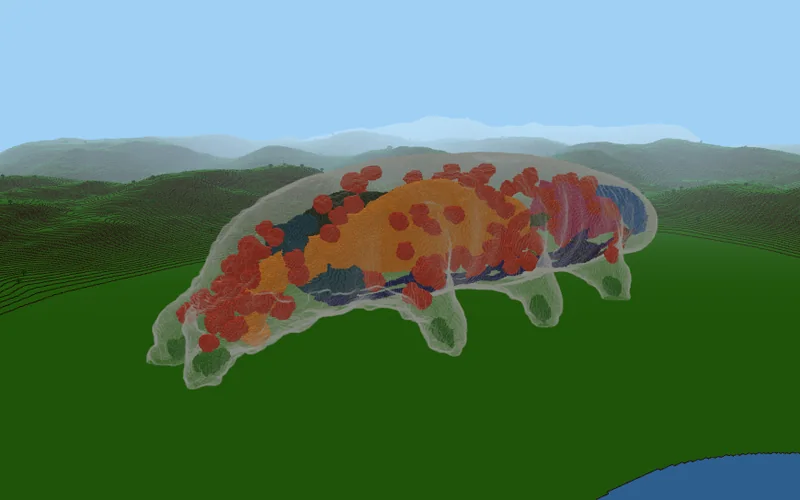
Tardigrade in blocks
One block per voxel: 608 blocks long, 3.7 million times life size. Watch it build, walk through the X-ray in stone, then take it into Minecraft.

Embryo
An egg that divides, folds and builds its organs stage by stage to hatching, timed against seven published sources, with the four cells that become the germline.
How this is built
- Data
- Gross et al. 2019's X-ray scan of one adult (CC BY 4.0) for the glass animal and the blocks; Gross & Mayer 2019's leg muscles (data CC0); Anderson et al. 2024's footsteps (paper CC BY 4.0, repository with no licence stated); for the embryo, stage timings from Gabriel et al. 2007, the Heikes et al. 2023 lineage and the staging papers since.
- Built with
- Our Python scripts turn the scans into meshes and blocks (
build_meshes.py,build_muscles.py,export_minecraft.py), and three.js draws them in the browser. The embryo is our own simulation in one web page, with every rule written into the graph. - Checked
- Organ volumes match the scan's paper (the traced body within 0.3%). The embryo's early stages are tested against the published timings (pass or partial) and its cell count at hatching (close). Each topic page below lists its own checks.
- Limits
- One animal, fixed and dried for scanning. The muscles and footsteps come from other animals, fitted to this one. From elongation on, the embryo's shapes are prescribed.
- More
- How the whole project is built
How it was made
One page per piece of work: what we built, how we built it, the data it came from, and what's still uncertain.
Anatomy and movement
The X-ray tomographFrom unnamed label files to named organs, a traced body and a registered head scan. Leg musclesFifty muscles per side, named from a colour code and fitted into the scanned animal from confocal scans of another. WalkingThe scanned animal steps leg by leg to hand-tracked footsteps from video. Voxels to blocksThe scan as a Minecraft build, and the raw X-ray as stone.Genetics and genomics
Genomes, genes and what we foundWe joined two developmental datasets on one genome, answered a question about condensin, and measured how much tardigrade a genome AI has seen.Development
Growing the embryoSeven sources reconciled into one timeline, cell cycles from a nine-embryo lineage, a dataset's clock set right, and organs from egg to hatching.All tardigrades
Every tardigrade speciesThe world checklist as a tree you can search: 1,550 species, living and fossil, each with a page of its records, genomes and papers.Share and reuse
ResourcesMeshes for 3D printing, label volumes, schematics, gait data, tools, and how to cite. Build logDated write-ups of each session, with pictures. CreditsEvery data source and licence.What we have been building, and what went wrong
Written as it happens, including the parts that failed. Corrections stay on the page, dated, because how a thing was found is worth as much as the thing.
-
21 September 2026
The day we checked our own numbers
We went to close an open question about our own work and found the number underneath it was wrong: a published figure of 28% was really 42%, because a table built by pivoting our graph counted each claim once per structure it touched. Then we measured whether this site can be read at all and found that 88% of it could not — the species pages built every link in JavaScript, so 884,673 words were unreachable by anything that does not run a browser. Then we found the public build was deleting the evidence behind the glass tardigrade. All three are fixed. Two prior-art searches cost us a headline each, and one handed back three times the data we had.
Out of it: how the tardigrade eye is wired · every species, now reachable · the glass tardigrade, with its evidence · the corrected nervous-system table
-
20 September 2026
A nerve cord measured, a claim killed, and an algorithm borrowed from contract theory
We measured the tardigrade's four trunk ganglia, which nobody had done, from label fields someone else released and never used that way. We published a claim that half the animal was nerve and knocked it down by lunchtime. And we tested whether a real embryo is built the way our model builds one, using equations published in 2019 for designing honest contracts — a completely unrelated field, the same algebra.
Out of it: the nervous system · the embryo engine · the findings table
-
19 September 2026
A preprint, a DNA tree, and a drawing for every genus
The condensin II preprint published, and its clasp modelled onto the ring. A DNA tree of 412 species built from public sequence and checked against the official checklist. A drawing or a photograph for 94 genera, each one openly licensed and credited.
Out of it: genetics and genomics · the DNA tree · where the research happens
-
18 September 2026
It hatched, and the site grew to every tardigrade
The simulated embryo ran all the way to hatching. Fifty leg muscles a side went into the glass animal. And the site grew a page for every one of the 1,551 named tardigrade species.
Out of it: the life cycle · leg muscles · the figure library
Watch it walk, and build
Free to share with credit. Each comes in three shapes: wide (X, Facebook, YouTube), square (Instagram feed) and tall (Reels, Stories, TikTok).
How this is built
- Data
- The same data as the viewers: Gross et al. 2019's scan and Anderson et al. 2024's footsteps, credited in every frame.
- Built with
- Our scripts
record_walk.mjs,record_turntable.mjsandrecord_build.mjsdrive the viewers in a browser (Playwright), save one frame at a time, and join them into H.264 video with ffmpeg at 30 frames per second. Each shape is rendered at its own size, not cropped. - Checked
- Not tested against data: they replay the viewers, whose checks are on each topic page.
- Limits
- They show the viewers as they were when recorded.
- More
- Resources · how the whole project is built
Get in touch
The project is run by Meow-Ludo Meow-Meow in Canberra. If you want to work on something here, have data sitting unused, spot an error, or want to use any of this in teaching — write. There is no form and no onboarding; there is a person who answers.